



 +91-6280082254

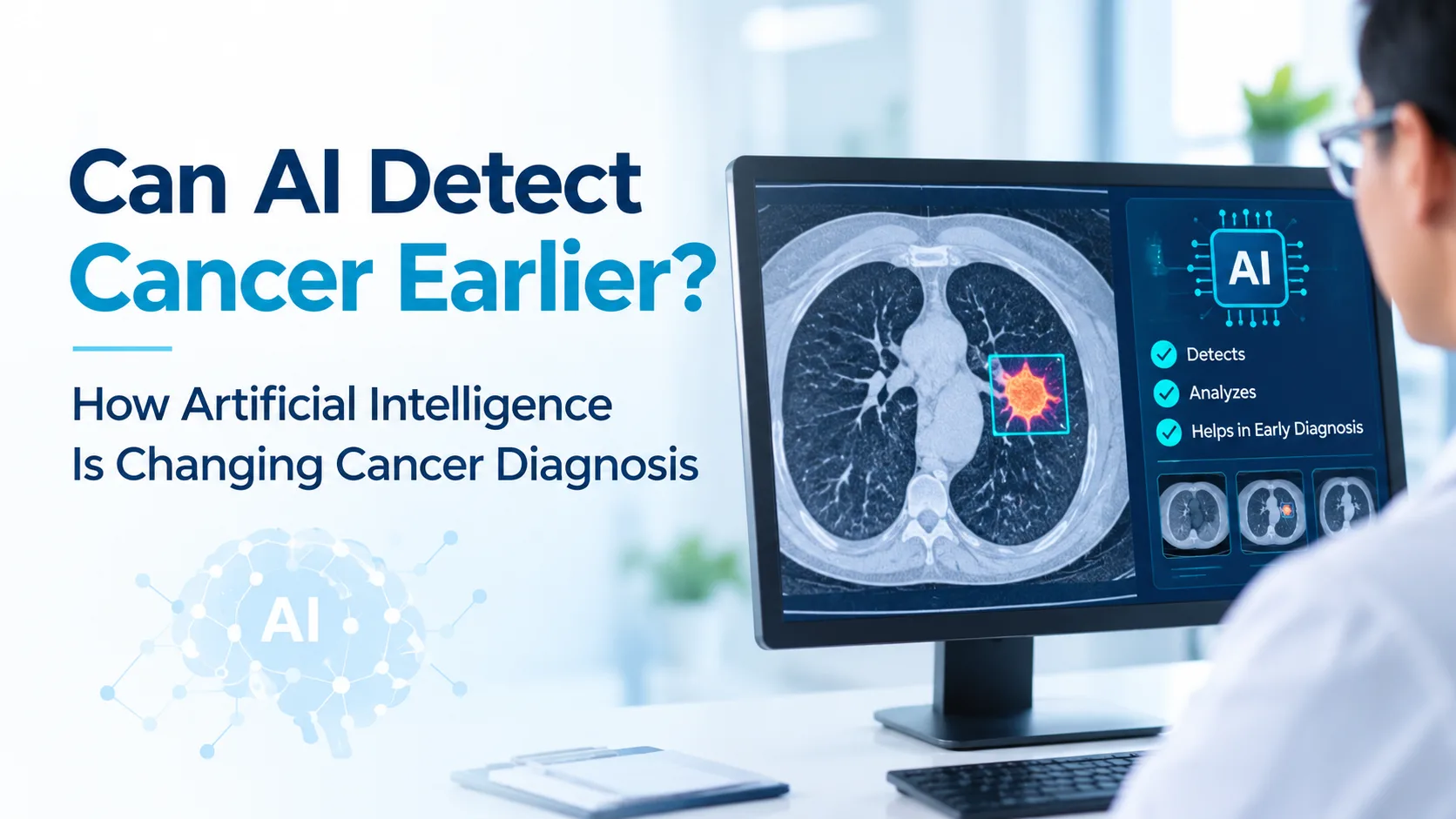
A few years ago, the idea of a computer helping to find cancer would have sounded like science fiction. Today, many patients ask a very direct question: can artificial intelligence find cancer before a doctor can?
The short answer is that AI is showing real promise as a support tool, but it is not a replacement for a cancer specialist. Researchers and hospitals are studying and using AI in medical imaging, pathology, screening and risk assessment. In these areas, it can help clinicians spot patterns that may be difficult or time-consuming to find.
It is important to be clear from the start. AI does not give a definitive cancer diagnosis on its own. What it can do is act as an extra set of eyes, helping doctors look more carefully and prioritise the cases that need attention first.
In this article, we explain how AI is being used in cancer detection, what it can and cannot do, and what you should do if an AI tool flags something concerning.
What Is Artificial Intelligence in Cancer Care?
Artificial intelligence, or AI, refers to computer systems that can perform tasks that normally need human judgement, such as recognising patterns in images or making predictions from data.
Most AI used in medicine today is based on machine learning. In simple terms, machine learning means a computer program learns from examples instead of following a fixed set of instructions written by a programmer.
Think of how a young doctor learns to read scans. After seeing thousands of images, they start to recognise what looks normal and what looks suspicious. A machine learning system does something similar. It is shown a very large number of medical images or data points, along with the known outcomes, and it gradually learns which patterns are linked to disease.
This is what makes AI different from a traditional computer program. A traditional program follows rules written by a person, such as "if this number is above this value, show a warning." An AI system works out its own patterns from data, which allows it to handle complex information that is hard to reduce to simple rules.
That is also why large, high-quality datasets matter so much. An AI tool is only as good as the data it learned from. If that data is limited, poorly labelled or not representative of the patients who will be tested, the tool may not perform well in real life.
How Is AI Being Used in Cancer Detection?
AI is being explored at several stages of the cancer journey. Here are the main areas where it is being researched or used as a clinical support tool.
AI and Medical Imaging
Imaging is where AI has made some of its biggest advances. Algorithms can be trained to analyse CT scans, MRI scans, mammograms, ultrasound images, PET/CT scans and other types of medical images.
In practice, an AI system may highlight an area that looks suspicious so the radiologist can examine it more closely. Some systems also help sort the daily workload, flagging scans that may need quicker review so that urgent cases are not left waiting in a long queue.
The radiologist still reviews the images and makes the final interpretation. The AI is there to assist, not to take over.
AI in Pathology
Pathology is the study of tissue samples under the microscope, and it is central to confirming most cancers. With digital pathology, glass slides are scanned into high-resolution digital images, which makes it possible for AI tools to analyse them.
Potential uses include identifying abnormal cells, detecting tumour areas on a slide, helping classify the type of tumour and measuring certain features that are tedious to count by hand. These measurements can be more consistent when supported by software.
Even so, pathologists remain responsible for interpreting the findings and establishing the diagnosis. AI is a helper in the laboratory, not the decision-maker.
AI in Colon and Colorectal Cancer Detection
Colorectal cancer often begins as a small growth called a polyp, and removing polyps during colonoscopy can prevent cancer from developing. This makes the quality of a colonoscopy very important.
AI-assisted colonoscopy uses computer-aided detection software that watches the live video from the scope and alerts the doctor when it notices something that may be a polyp or abnormal area. It is like having a second observer that never gets tired.
This raises an interesting question: could AI help doctors miss fewer small lesions during colonoscopy? Several studies have suggested that computer-aided systems can increase the detection of small polyps. Researchers are still studying how much this translates into better long-term outcomes for patients, and results can vary between systems and settings.
AI in Breast Cancer Detection
Mammography is one of the most widely studied areas for AI. Algorithms can be trained to look at mammograms and other breast imaging, and to point out patterns that may be suspicious.
In research settings, AI has been explored both as a second reader alongside a radiologist and as a tool for sorting screening mammograms by level of concern. The goal is to support radiologists in interpretation and, in some cases, to ease the heavy workload of screening programmes.
As with other areas, the radiologist's judgement and further tests remain essential before any diagnosis is made.
AI in Lung Cancer Detection
Small spots in the lung, called pulmonary nodules, are often found on CT scans. Most are harmless, but a few may be early cancers, and telling the difference can be difficult.
AI tools can help detect these nodules, measure them and track how they change over time. They may also help radiologists prioritise the scans that show the most worrying findings. Again, the final assessment is made by the specialist team.
Can AI Detect Cancer Before Symptoms Appear?
To answer this properly, it helps to understand two different terms.
Screening means testing people who have no symptoms, in order to find a possible disease early. Diagnosis means investigating a person who already has symptoms or an abnormal test result.
AI may help improve certain screening processes. For example, it may help radiologists review screening images more efficiently or help identify people who may be at higher risk and deserve closer follow-up.
But this does not mean AI can currently predict or detect every cancer before symptoms appear. For many cancers, there is no reliable screening test at all, and AI cannot create one out of thin air. It can only work with the information available to it.
This distinction is important for medical accuracy, and it is the reason you should be cautious about headlines that suggest AI can spot any cancer years in advance.
Can AI Detect Cancer That Doctors Miss?
Sometimes, yes. AI can pick up subtle patterns that may be hard for the human eye to notice, especially on a busy day or in a very large set of images. In this way, it can act as a second set of eyes.
But it is equally important to understand the other side of the story. AI is not perfect, and it is not magic.
AI can miss cancers. It can also raise false alarms, flagging something harmless as suspicious. The performance of different systems can vary a lot, and a tool that works well in one hospital may not perform the same way in another.
Results also depend on the quality of the images or data. A blurry scan or incomplete information can reduce accuracy. And any AI tool needs proper clinical validation, which means it must be tested carefully in real patients before it is trusted in routine care.
So a balanced view is this: AI can help doctors catch things they might otherwise overlook, but doctors are also needed to catch the things AI gets wrong.
AI and Early Cancer Detection: What Are the Potential Benefits?
When it is used carefully, AI may offer several advantages in cancer care.
Faster Analysis
AI can process large numbers of images or large amounts of data in a short time. This may help reduce waiting times and speed up the first review of a scan.
Detection of Subtle Patterns
Some algorithms can identify very fine patterns that are hard to recognise consistently, even for experienced specialists. This may be especially useful for small or early changes.
Supporting Radiologists and Pathologists
AI can work as an additional decision-support layer. It does not make the decision, but it gives the specialist more information to consider.
Prioritising High-Risk Cases
Certain systems can help identify scans or samples that may need more urgent attention, so that the most concerning cases are reviewed earlier.
More Consistent Measurements
AI may help measure tumour size or other features in a more standardised way. This can be useful when comparing scans over time to see how a tumour is responding to treatment.
What Are the Limitations of AI in Cancer Diagnosis?
A responsible discussion of AI must be honest about its weaknesses. These are the main concerns doctors and researchers talk about.
False-positive results happen when the tool flags a problem that is not really there. This can lead to anxiety, extra tests and sometimes unnecessary procedures. False-negative results are the opposite, when the tool misses a real cancer, which can give false reassurance.
Bias in training data is another concern. If an AI system was trained mostly on data from one group of people or one type of hospital, it may not work as well for patients from different backgrounds, ages or populations. Differences between hospitals, scanners and imaging protocols can also affect results.
Poor-quality or incomplete data lowers accuracy, and many tools have not yet been validated across different settings. There are also regulatory and clinical limitations, as approval and guidelines for medical AI are still evolving in many countries.
Finally, there is the risk of over-reliance. If clinicians trust an automated result too much, they may stop questioning it. That is why the guiding principle is simple: AI should assist clinical decision-making, not replace clinical judgement.
Can AI Tell What Type of Cancer a Patient Has?
Many patients imagine that an AI scan can simply tell you whether you have cancer and what kind it is. The reality is more complicated.
AI can potentially help with classification and characterisation. For example, it may help suggest whether a lesion looks more likely to be benign or malignant, or help group tumours by certain features.
But diagnosing cancer usually requires a combination of things: a clinical assessment, imaging, laboratory findings, pathology, the patient's medical history and, in some cases, molecular or genetic testing. For many cancers, a biopsy remains central to confirming the diagnosis.
AI can contribute to several of these steps, but it does not replace the need to put the whole picture together.
AI, Biomarkers and the Future of Cancer Detection
Some of the most exciting work in this field is happening at the intersection of AI and molecular science. It is worth describing, as long as we are clear that much of it is still emerging.
Researchers are studying blood-based biomarkers and liquid biopsy, which look for tiny traces of tumour material in the blood. They are also examining genomic data and molecular profiling, which reveal the genetic changes inside a tumour.
AI is being explored as a way to make sense of these huge and complex datasets. A related idea is multi-modal AI, which combines different kinds of information, such as imaging, pathology and clinical details, to build a more complete picture.
These are developing applications. Some are used in specific clinical situations, while many are still being tested in research studies. They should not be presented as routine tests that can detect every cancer, and patients should be cautious about any service that makes such a claim.
Could AI Help Personalise Cancer Treatment?
The role of AI is not limited to detection. Researchers are also investigating how it may help with decisions after a diagnosis.
Areas of study include predicting how a patient may respond to a particular treatment, estimating risk levels to help guide how intensive treatment should be, supporting treatment planning and characterising tumours in more detail. AI is also being studied as a way to estimate the risk of cancer coming back after treatment.
In the long run, these tools may support multidisciplinary teams in making more individualised decisions. For now, most of these applications are being evaluated, and the decision always rests with the treating specialists and the patient.
Will AI Replace Oncologists, Radiologists or Surgeons?
No, not based on how AI is currently being integrated into cancer care.
Cancer treatment involves far more than recognising a pattern on an image. A cancer specialist has to consider the patient's overall health, the stage of the cancer, the biology of the tumour, the imaging and pathology findings, the available treatment options, whether surgery is feasible, the risks and possible complications, the patient's own preferences and the likely recovery and quality of life.
AI can support parts of this process. But weighing all these factors together, and talking through them with a patient and their family, is a human responsibility that requires experience, judgement and empathy.
How AI Could Change Cancer Surgery
Surgery is another area where AI is being explored, although most applications are still at the research or early-adoption stage.
Before an operation, AI may help analyse imaging to understand the extent of a tumour and its relationship to nearby structures. This could support surgical planning and help with tumour localisation. Some tools are also being studied to help predict surgical risks and to estimate outcomes after surgery.
During surgery, researchers are investigating intraoperative navigation systems and assistance for robotic platforms. After surgery, AI may help predict complications or recovery patterns.
It is important to separate two ideas that are often confused. A surgical robot is not automatically an AI system. Robotic-assisted surgery, as it is used today, means that the surgeon controls the robotic instruments from a console, using advanced technology to achieve precision in a minimally invasive way. AI is a different layer, and where it is used alongside surgery, it supports the surgeon rather than operating on its own.
A surgical oncologist brings together the imaging, the pathology and the individual patient's needs to decide the right operation. Technology can improve the information available, but the surgical judgement remains with the surgeon.
What Should Patients Do If an AI Tool Flags Something Suspicious?
If an AI-based tool or report flags something on your scan or test, try not to panic. An AI-generated alert is not the same as a cancer diagnosis. It means that further evaluation may be appropriate.
The usual next steps are as follows:
- Review by an appropriate specialist, such as a radiologist, oncologist or surgical oncologist.
- A clinical assessment, including your symptoms and medical history.
- Additional imaging or tests if they are needed.
- Pathological confirmation, such as a biopsy, when indicated.
- A treatment plan based on the complete clinical picture, if a diagnosis is confirmed.
The key message is to take the alert seriously, but not to treat it as a final answer. Share the report with a qualified specialist and let them guide you through what it means for you.
Is AI Cancer Detection Available in India?
AI-based medical technologies are increasingly being evaluated and adopted in healthcare around the world, and India is no exception. Interest is growing in areas such as imaging analysis, digital pathology and screening support.
However, availability varies. It depends on the hospital, the specific technology, the type of cancer and the clinical purpose. A tool that is used in one centre may not be available in another, and not every AI product has the same level of evidence behind it.
If you are curious about whether a particular AI-assisted test or scan is available and appropriate for your situation, the best step is to ask your treating doctor or the hospital directly. They can tell you what is actually offered and whether it makes sense in your case.
What Does the Future of AI in Cancer Diagnosis Look Like?
The future looks promising, and many experts expect AI to become an increasingly common part of cancer care.
We may see more accurate image analysis, wider use of AI-assisted pathology and better tools for identifying suspicious lesions earlier. Personalised cancer risk prediction may improve, and systems that combine imaging, pathology and genomic data may offer a more complete view of each patient. Over time, these advances could support better clinical decision-making and more individualised treatment planning.
But these benefits will not arrive automatically. They depend on careful clinical validation, patient safety, appropriate regulation, data privacy and responsible implementation. The most successful future is likely to be one in which technology and clinicians work together, each doing what they do best.
Key Takeaways
- AI is increasingly being studied and used as a tool in cancer detection and diagnosis.
- It can assist with medical imaging, pathology and screening.
- AI may help identify subtle or suspicious patterns.
- AI can produce both false-positive and false-negative results.
- An AI alert does not equal a cancer diagnosis.
- Biopsy and pathology remain important for confirming many cancers.
- AI is intended to support clinicians rather than replace them.
- The future may involve AI helping doctors make faster and more personalised cancer-care decisions.
Frequently Asked Questions (FAQs)
Need Expert Guidance on a Scan Report or Symptom?
Whether a concern has come from an AI-assisted report, a routine scan or a symptom that will not go away, the next step is the same: a careful review by a specialist. Dr. Lovedeep Singh Chauhan, Consultant Surgical Oncologist at Max Super Speciality Hospital, Mohali, reviews imaging, biopsy and staging findings with patients and plans treatment in a multidisciplinary setting. To book a consultation, please visit the Contact page or call +91-62800-82254.
Medical Disclaimer
This article is for general awareness and does not replace personal medical advice. Please consult a qualified doctor for any health concern.
Dr. Lovedeep Singh Chauhan
Dr. Lovedeep Singh Chauhan is a Consultant in Surgical Oncology at Max Super Speciality Hospital, Mohali. He has received advanced training in cancer surgery from leading national institutes (Tata Memorial Hospital, Mumbai) and has extensive academic, clinical, and research experience across multiple subspecialties of surgical oncology.


